EOT Crane: Complete Guide, Types, Uses & Benefits in 2026
An EOT Crane, or Electric Overhead Travelling Crane, is an electrically powered industrial lifting system used to lift, lower and move heavy materials horizontally within a defined working area. EOT cranes are widely used in manufacturing plants, engineering workshops, warehouses, automobile industries, steel plants, foundries, fabrication units and other material-handling applications.
Unlike conventional lifting equipment that occupies valuable floor space, an EOT crane generally operates above the working area on runway rails. This allows industries to move heavy loads efficiently while keeping the factory floor available for production and storage.
WSP Cranes & Services provides EOT cranes and a wide range of industrial material-handling solutions. According to its website, WSP has delivered 1,200+ tailor-made solutions across India and serves industries including automotive, aerospace, chemical, pharmaceutical, manufacturing, steel, glass, foundries and heavy engineering.
Frequently Asked Questions About EOT Cranes
What is an EOT crane?
An EOT crane is an Electric Overhead Travelling Crane used to lift, lower and horizontally transport materials using an electrically powered bridge, trolley and hoisting system.
How does an EOT crane work?
An EOT crane works through three primary movements: hoisting, cross travel and long travel. The hoist raises or lowers the load, the trolley moves the load across the bridge and the bridge travels along the runway.
What are the main types of EOT cranes?
The two major EOT crane configurations are Single Girder EOT Cranes and Double Girder EOT Cranes. Other configurations include underslung EOT cranes and specialized cranes designed for particular applications.
What is the difference between a single girder and double girder EOT crane?
A single-girder crane has one main bridge girder, while a double-girder crane has two. Double-girder designs are generally preferred for higher capacities, larger spans and heavier-duty applications.
What is the lifting capacity of an EOT crane?
EOT crane capacity depends on the design and application. Different cranes can be engineered for different safe working loads. Capacity should always be specified according to the actual application rather than selecting a crane based only on a general capacity range.
Where are EOT cranes used?
EOT cranes are used in manufacturing plants, warehouses, automotive facilities, steel plants, foundries, engineering workshops, fabrication units, ports and other industrial environments.
What are the advantages of an EOT crane?
The major advantages include efficient heavy-load handling, reduced manual handling, improved productivity, better floor-space utilization, controlled load movement and customizable configurations.
What is an EOT crane made of?
An EOT crane generally includes structural steel bridge components, end carriages, wheels, motors, gearboxes, an electric hoist, trolley, hook, electrical controls and safety systems. The exact components depend on the crane design.
How is an EOT crane manufactured?
EOT crane manufacturing generally involves requirement analysis, engineering design, structural fabrication, mechanical assembly, electrical integration, surface protection, inspection, testing, installation and commissioning.
How do I choose an EOT crane manufacturer?
Look for a manufacturer with appropriate engineering capability, manufacturing experience, quality systems, relevant industrial experience, customization capability, installation support and after-sales service.
How do I select the right EOT crane for my factory?
Start with the required load capacity, span, lifting height, duty cycle, operating frequency, building structure, available headroom, operating environment and required travel speeds. A crane manufacturer can then develop the appropriate configuration.
Quick Answer: What Is an EOT Crane?
An EOT crane is an electrically operated overhead crane that travels on runway rails to lift, lower and move loads from one location to another.
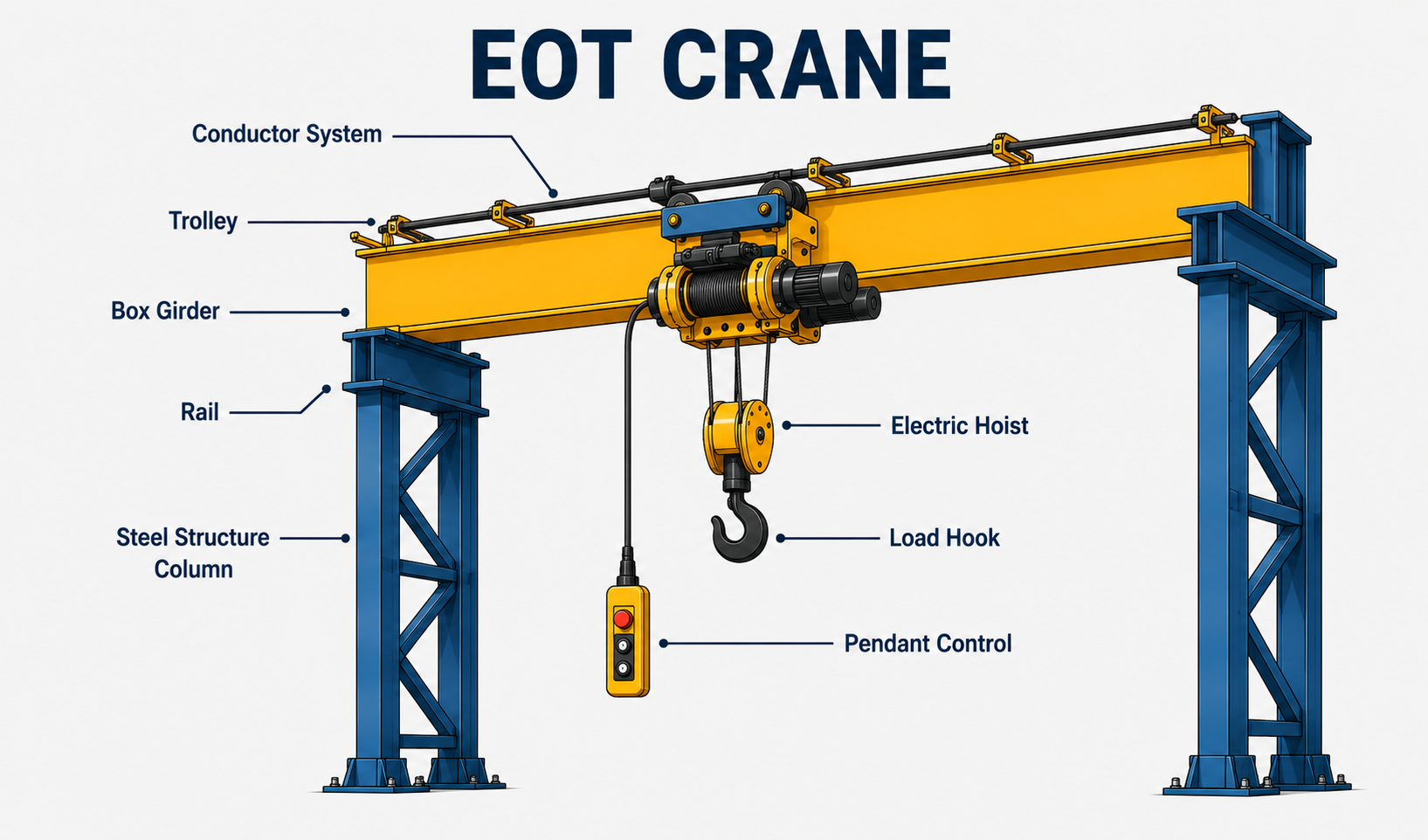
An EOT crane typically consists of a bridge structure, one or two main girders, end carriages, a trolley or crab, an electric hoist, lifting hook, motors, electrical controls and safety devices.
The crane normally performs three primary movements:
- Hoisting: Moving the load vertically up and down.
- Cross Travel: Moving the hoist or trolley horizontally across the bridge.
- Long Travel: Moving the complete crane along the runway.
This combination gives an eot crane controlled three-dimensional load movement within its designed operating area.
What Does EOT Stand For?
EOT stands for Electric Overhead Travelling.
The name describes how the crane operates:
- Electric: The crane's lifting and travelling mechanisms are electrically powered.
- Overhead: The crane operates above the factory floor.
- Travelling: The bridge travels along runway rails.
EOT cranes are therefore particularly useful where industries need frequent and controlled movement of heavy materials across a production or storage area.
How Does an EOT Crane Work?
The EOT crane working principle is based on coordinated movement between the hoisting mechanism, trolley and crane bridge.
When an operator gives a command through a pendant control, radio remote or cabin control, the appropriate electric motor operates the required mechanism.
Step 1: Load Attachment
The lifting hook is positioned above the material to be moved. The load is securely attached using an appropriate lifting accessory such as a sling, hook attachment, spreader or other approved lifting device.
Step 2: Hoisting
The electric hoist operates the drum or chain mechanism to raise the load vertically. In a wire-rope hoist, the wire rope winds onto a drum and moves the hook block upward.
Step 3: Cross Travel
After the load reaches the required height, the trolley or crab travels along the crane girder. This moves the suspended load sideways across the working span.
Step 4: Long Travel
The complete bridge travels along the runway rails using the long-travel drive system. This allows the load to move to another location within the crane's operating area.
Step 5: Load Lowering
Once the load reaches the destination, the hoist lowers it in a controlled manner.
Step 6: Positioning
The operator stops the crane after positioning the load at the required location. Modern crane systems can use variable-frequency drives (VFDs) to provide smoother acceleration and deceleration.
In simple terms:
Hoist = Up/Down
Trolley = Left/Right
Bridge = Forward/Backward
This coordinated movement is the foundation of an EOT crane's operation.
Main Components of an EOT Crane
Understanding the main components makes it easier to understand how an EOT crane works.
1. Bridge Girder
The bridge girder is the main structural member of the crane. Depending on the crane design and load requirement, the bridge can have a single girder or two girders.
2. End Carriages
End carriages, also called end trucks, are fitted at the ends of the bridge. They contain wheels and drive mechanisms that allow the crane to travel along the runway.
3. Trolley or Crab
The trolley, commonly referred to as a crab, carries the hoisting mechanism and moves across the crane bridge.
4. Electric Hoist
The hoist provides the lifting and lowering function. Depending on the application, the crane can use an electric wire-rope hoist or electric chain hoist.
5. Lifting Hook
The hook connects the crane's lifting mechanism to the load.
6. Motors and Gearboxes
Electric motors provide movement, while gearboxes transmit and control torque for lifting and travelling operations.
7. Electrical Control Panel
The control panel manages the crane's electrical systems and operating commands.
8. Runway Rails
Runway rails provide the travel path for the crane bridge.
9. Festoon or Power Supply System
A power supply system transfers electrical power to the travelling crane and trolley mechanisms.
10. Safety Devices
Depending on the crane design, safety equipment can include overload protection, limit switches, emergency stop systems, brakes, buffers, anti-collision systems and other protective devices.
How Are EOT Cranes Manufactured?
The manufacturing of an EOT crane is an engineering process that combines structural design, mechanical fabrication, electrical systems, assembly, testing and quality inspection.
A typical EOT crane manufacturing process includes the following stages.
1. Understanding the Customer Requirement
The manufacturer first evaluates the application and operating conditions.
Important parameters include:
- Required lifting capacity
- Crane span
- Lifting height
- Runway length
- Duty cycle
- Operating environment
- Required lifting speed
- Cross-travel speed
- Long-travel speed
- Available headroom
- Power supply
- Control method
- Indoor or outdoor installation
Correct specification is important because an EOT crane must be engineered according to the actual material-handling requirement.
2. Crane Design and Engineering
Engineers develop the crane configuration based on the required capacity, span, lifting height and duty requirements.
Structural and mechanical components are designed to provide appropriate strength, stability and operating performance.
WSP Cranes states that its crane solutions are designed around customer requirements and that it provides customized material-handling solutions across different industries.
3. Structural Fabrication
The main girders, end carriages and other structural components are fabricated from suitable structural materials.
Fabrication can include:
- Cutting
- Welding
- Drilling
- Machining
- Alignment
- Surface preparation
- Dimensional inspection
The bridge structure must maintain the required geometry and alignment for safe and reliable operation.
4. Mechanical Component Assembly
Mechanical systems such as:
- Hoists
- Gearboxes
- Motors
- Wheels
- Brakes
- Drums
- Couplings
- Hook blocks
- Trolleys
are assembled and integrated into the crane system.
5. Electrical Installation
Electrical components are installed according to the crane's control architecture.
These can include:
- Control panels
- Motors
- VFDs
- Limit switches
- Pendant controls
- Radio remote controls
- Cable systems
- Emergency stop circuits
- Safety interlocks
6. Painting and Surface Protection
After fabrication and inspection, structural components are prepared and coated with suitable protective paint systems according to the operating environment.
7. Assembly and Testing
The crane is assembled and inspected before installation at the customer's facility.
Testing can include checks for:
- Structural alignment
- Hoisting operation
- Trolley movement
- Long-travel movement
- Brake operation
- Limit switches
- Electrical controls
- Safety systems
- Load-handling performance
8. Installation and Commissioning
After delivery, the crane is installed on the prepared runway system. The manufacturer or installation team completes commissioning and operational checks before handing the system over for use.
Important: Actual manufacturing procedures, inspection requirements and testing criteria vary according to the crane design, applicable standards, site conditions and customer specifications.
Types of EOT Cranes
EOT cranes can be categorized according to girder configuration, installation arrangement, capacity, duty class, application and operating environment.
The two most common configurations are Single Girder EOT Cranes and Double Girder EOT Cranes.
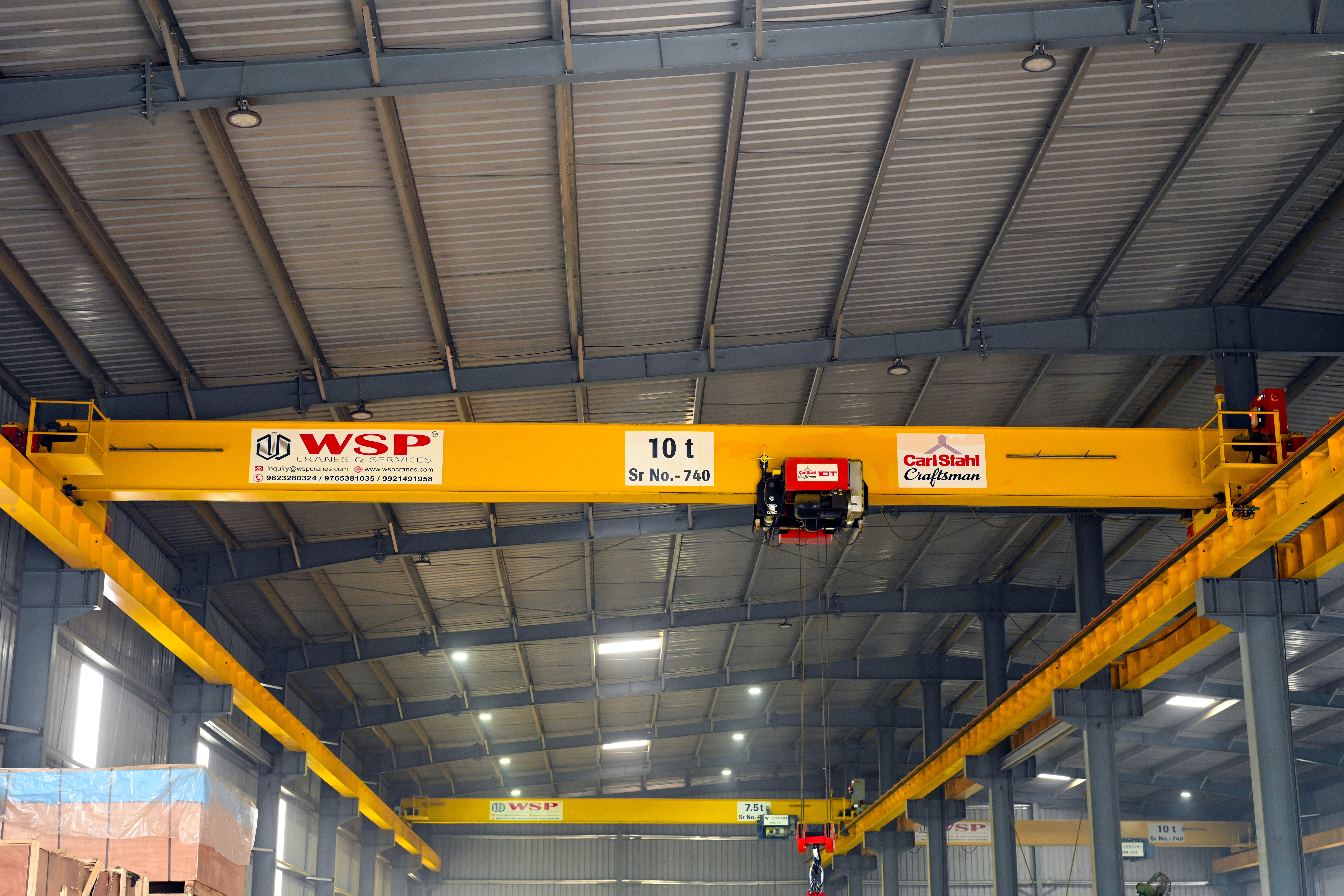
1. Single Girder EOT Crane
A Single Girder EOT Crane uses one main bridge girder supporting the trolley and hoisting system.
It is commonly selected for light- to medium-duty material handling where economical operation, efficient space utilization and reliable lifting are required.
Typical applications include:
- Manufacturing plants
- Engineering workshops
- Warehouses
- Assembly areas
- Maintenance facilities
- Fabrication units
WSP currently describes its single-girder EOT cranes as solutions for light- to medium-duty applications, with published ranges depending on the configuration and project requirements.
Advantages of Single Girder EOT Crane
- Economical initial investment
- Relatively lightweight structure
- Suitable for many general industrial applications
- Efficient material handling
- Straightforward maintenance
- Good utilization of available factory space
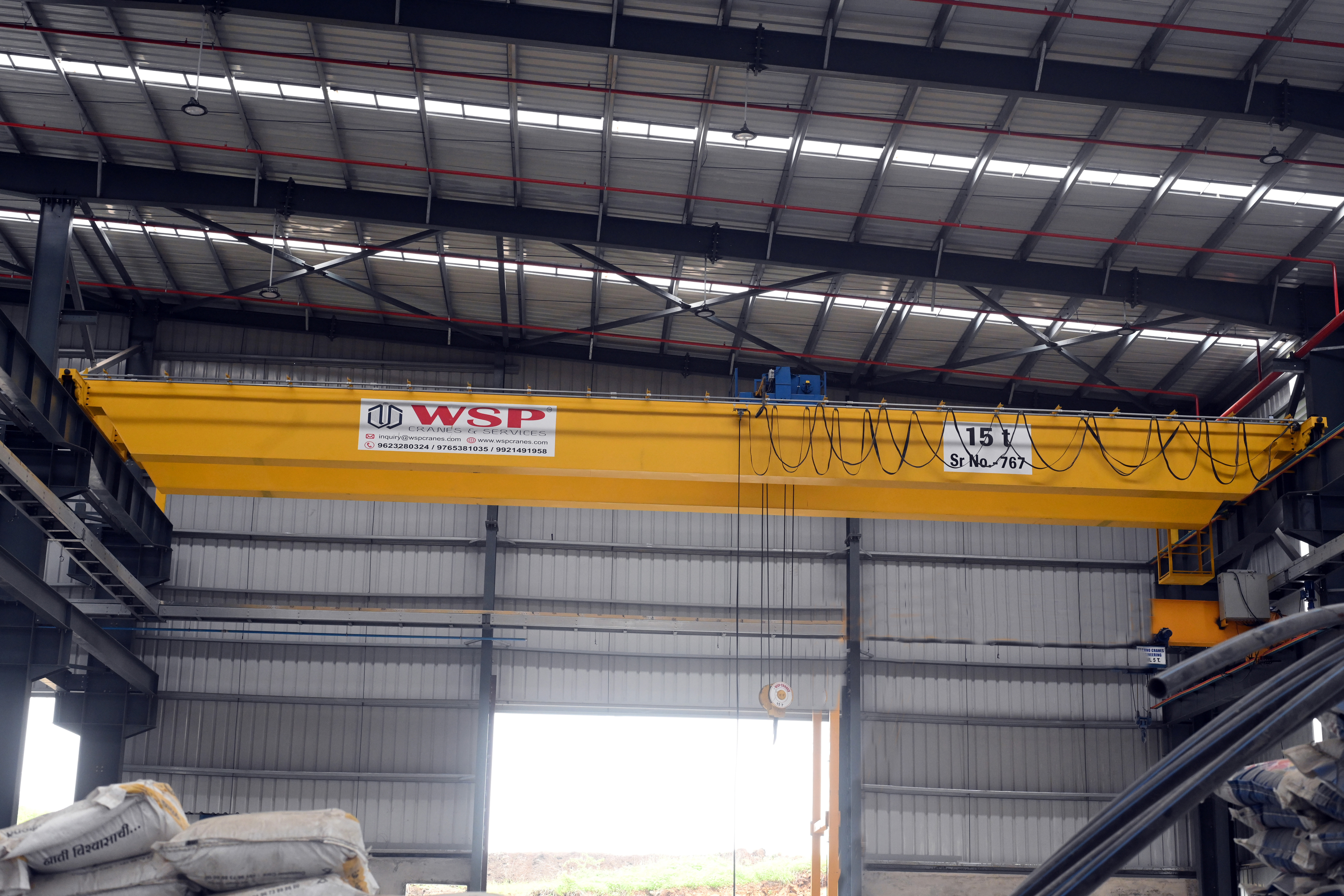
2. Double Girder EOT Crane
A Double Girder EOT Crane uses two parallel bridge girders. The arrangement provides greater structural capacity and is commonly selected for heavier loads, larger spans and demanding operating conditions.
WSP describes double-girder EOT cranes as heavy-duty solutions for applications requiring higher lifting capacity, stability and long-term performance.
Advantages of Double Girder EOT Crane
- Higher lifting capacity
- Suitable for heavy-duty applications
- Greater structural rigidity
- Suitable for larger spans
- Can provide greater hook height depending on configuration
- Suitable for demanding industrial environments
Single Girder vs Double Girder EOT Crane
| Feature | Single Girder EOT Crane | Double Girder EOT Crane |
|---|---|---|
| Bridge Girders | One | Two |
| Typical Application | Light to medium duty | Medium to heavy duty |
| Structural Weight | Lower | Higher |
| Initial Cost | Generally lower | Generally higher |
| Heavy Load Handling | Limited by design | Better suited |
| Large Span Applications | Suitable for selected applications | Highly suitable |
| Hook Height | Depends on design | Can be optimized for greater hook height |
| Typical Industries | Manufacturing, workshops, warehouses | Steel, heavy engineering, fabrication, foundries |
The correct choice should always be based on capacity, span, duty cycle, lifting height, operating frequency and site conditions rather than price alone.
Other Crane Types and Material-Handling Solutions
EOT cranes are only one part of an industrial lifting and material-handling system. Depending on the facility, other crane configurations may provide a better solution.
Goliath Crane
A Goliath Crane, commonly known as a gantry crane, is supported by legs that travel on ground-level rails or a prepared travel path.
It is particularly useful for outdoor yards, construction areas, precast plants and applications where an overhead runway structure is not practical.
Single Girder Goliath Crane
A single-girder configuration designed for applications where the load and operating requirements can be handled by one bridge girder.
Double Girder Goliath Crane
A double-girder configuration designed for heavier loads and more demanding applications.
Semi Goliath Crane
A Semi Goliath Crane combines features of an overhead crane and a gantry crane. One side can operate on an elevated runway while the other side travels on a ground-level rail.
This configuration can be useful where building layout, available floor space or existing structures make a conventional overhead crane impractical.
Single Girder Semi Goliath Crane
Suitable for applications requiring a semi-gantry arrangement with a single main girder.
Double Girder Semi Goliath Crane
Designed for heavier-duty applications where a two-girder bridge arrangement is required.
JIB Crane
A JIB Crane uses a horizontal or rotating boom attached to a vertical column or wall-mounted structure.
Jib cranes are generally useful for localized lifting and workstation material handling.
Common applications include:
- Machine loading
- Assembly stations
- Maintenance areas
- Work cells
- Material transfer points
Gantry Crane
A Gantry Crane is supported by legs and normally travels along a ground-level track or runway.
Gantry cranes are commonly used in:
- Outdoor storage yards
- Precast concrete plants
- Construction sites
- Heavy fabrication
- Material storage areas
Monorail Crane
A Monorail Crane or monorail lifting system moves a hoist along a fixed track or beam.
It is useful where material needs to follow a defined route instead of requiring complete two-dimensional crane coverage.
Underslung EOT Crane
An Underslung EOT Crane, also called an underhung crane, travels beneath the supporting runway structure.
It can be beneficial in facilities where headroom, building structure or floor-space utilization is a major consideration.
WSP lists underslung cranes among its material-handling products and describes underslung EOT configurations as useful where space and headroom are important considerations.
Light Crane Systems
For lighter loads and workstation-level handling, industries may use modular light crane systems instead of conventional heavy EOT cranes.
WSP's product portfolio includes:
- Light Rail System (LRS)
- KBK Light Crane System
- Light Crane System (LCS)
- Aluminium Light Crane System
These systems can be used for flexible workstation handling, assembly operations and repetitive movement of lighter materials. WSP lists these systems within its current product portfolio.
Pre-Engineered Crane Building
A Pre-Engineered Crane Building is designed to integrate the building structure with the required crane and material-handling system.
This approach can help coordinate:
- Building dimensions
- Crane runway arrangement
- Structural requirements
- Material flow
- Equipment positioning
- Future expansion considerations
Electric Wire Rope Hoist
An Electric Wire Rope Hoist uses an electric motor and wire rope mechanism for lifting loads.
It is widely used in EOT cranes, gantry cranes and other industrial lifting applications where reliable vertical lifting is required.
Electric Chain Hoist
An Electric Chain Hoist uses a chain mechanism to lift and lower loads.
It is often used for lighter-duty lifting applications and workstation material handling.
Chain Hoist
A Chain Hoist is a mechanical lifting device that uses a chain and gear mechanism to raise and lower loads. Depending on the design, chain hoists may be manually operated or integrated into powered systems.
Goods Lift
A Goods Lift is designed to move materials or goods vertically between different levels of a facility.
Goods lifts are commonly used in:
- Warehouses
- Manufacturing plants
- Industrial buildings
- Storage facilities
- Production units
They are intended for goods/material movement rather than passenger transportation unless specifically designed, certified and approved for that purpose.
Crane Kit
A Crane Kit generally refers to a set of major crane components used to build or upgrade a crane system.
Depending on the configuration, a crane kit may include components such as:
- End carriages
- Wheels
- Motors
- Gearboxes
- Controls
- Hoisting equipment
- Electrical components
The exact kit configuration depends on the project.
Transfer Trolley
A Transfer Trolley is used to move heavy materials horizontally from one location to another along a predefined path.
It can be useful when material needs to be transferred between:
- Production bays
- Assembly stations
- Storage areas
- Workshops
- Manufacturing lines
Crab Trolley
A Crab Trolley carries the hoisting mechanism and travels across the bridge girder of an EOT crane.
Its primary function is to provide the crane's cross-travel movement, allowing the suspended load to move laterally across the crane span.
Advantages of EOT Cranes
Why are EOT cranes widely used in industrial facilities?
1. Efficient Material Handling
EOT cranes can move heavy materials quickly and systematically across a factory or workshop.
2. Reduced Manual Handling
Mechanical lifting reduces dependence on manual handling for heavy loads, helping improve workplace efficiency.
3. Better Floor-Space Utilization
Because the crane operates overhead, valuable floor space can remain available for machinery, storage and production activities.
4. Precise Load Movement
Controlled hoisting, cross travel and long travel allow operators to position materials accurately.
5. Suitable for Heavy Loads
Double-girder and specialized EOT crane configurations can be engineered for demanding lifting requirements.
6. Improved Productivity
Efficient material movement can reduce waiting time between production stages and support smoother workflow.
7. Flexible Configuration
EOT cranes can be customized according to:
- Load capacity
- Span
- Lifting height
- Duty cycle
- Building dimensions
- Control system
- Operating environment
8. Long-Term Industrial Use
When correctly designed, installed, operated and maintained, industrial cranes can provide reliable service over a long operating life.
9. Multiple Control Options
Depending on the application, EOT cranes can be controlled through pendant controls, radio remote controls or operator cabins.
10. Integration With Industrial Operations
EOT cranes can be integrated into manufacturing, fabrication, warehousing and other material-handling workflows.
WSP positions its crane solutions around safety, productivity, durability and customized material handling across multiple industrial sectors.
Where Are EOT Cranes Used?
EOT cranes are suitable for a wide variety of industries.
Automotive Industry
Used for handling dies, components, assemblies, machinery and production materials.
Steel Plants
Used for moving steel products, equipment, raw materials and specialized loads.
Heavy Engineering
Used for handling machinery, fabricated structures and heavy components.
Foundries
Used for material handling in demanding production environments.
Manufacturing Plants
Used for moving raw materials, components and finished products.
Fabrication Workshops
Used for handling fabricated structures and heavy workpieces.
Warehouses
Used for lifting and transferring heavy materials within storage and dispatch areas.
Pharmaceutical and Chemical Industries
Specialized crane configurations can be designed for specific operating environments and handling requirements.
WSP lists automotive, aerospace, automobile, chemical, pharmaceutical, manufacturing, steel, glass, foundry, heavy engineering, port and precast applications among the industries it serves.
How to Choose the Right EOT Crane?
Selecting an EOT crane should start with the actual material-handling requirement.
Consider these factors:
1. Load Capacity
Determine the maximum safe working load that the crane must lift.
2. Span
Measure the distance between the runway rails and determine the required crane span.
3. Lifting Height
Identify the required hook height and available building headroom.
4. Duty Cycle
Consider how frequently the crane will operate and how demanding the lifting cycle will be.
5. Operating Environment
Consider whether the crane will operate indoors, outdoors, in high-temperature environments, dusty areas or other specialized conditions.
6. Travel Speeds
Select appropriate hoisting, cross-travel and long-travel speeds based on workflow requirements.
7. Control System
Choose between pendant, radio remote or cabin control depending on the application and operator requirements.
8. Building Structure
The crane runway and supporting structure must be suitable for the intended crane loads and operating conditions.
9. Maintenance Requirements
Consider accessibility of motors, brakes, gearboxes, electrical panels and other components for inspection and maintenance.
10. Applicable Standards
The crane should be designed, manufactured, tested and installed according to applicable regulations, standards and project requirements.
Standards and Compliance for EOT Cranes
EOT cranes should be designed, manufactured, tested and installed according to applicable regulations, standards and project requirements. In India, relevant standards such as IS 3177 provide requirements related to electric overhead travelling cranes and gantry cranes, including aspects of design, manufacture, inspection, testing and erection.
EOT Crane Safety: What Should You Know?
Safety should be a core consideration throughout the crane's lifecycle.
Important practices include:
- Never exceed the crane's rated capacity.
- Inspect lifting accessories before use.
- Ensure the load is properly secured.
- Do not stand or allow unauthorized personnel under a suspended load.
- Follow the manufacturer's operating instructions.
- Inspect hooks, ropes, chains, brakes and limit switches regularly.
- Carry out preventive maintenance.
- Train and authorize crane operators appropriately.
- Keep the operating area clear.
- Investigate unusual noise, vibration or operating behavior immediately.
- Maintain required inspection and maintenance records.
Crane operation and inspection should always follow applicable laws, regulations, manufacturer instructions and relevant standards.
EOT Crane Maintenance
Regular maintenance helps maintain crane performance and reliability.
A maintenance program may include inspection of:
- Wire ropes
- Hooks
- Hook blocks
- Brakes
- Motors
- Gearboxes
- Wheels
- Bearings
- Electrical panels
- Limit switches
- Control systems
- Structural components
- Runway rails
- Festoon systems
- Safety devices
The frequency and scope of maintenance should be established according to the crane's design, duty, operating environment, manufacturer recommendations and applicable requirements.
EOT Crane vs Gantry Crane: What Is the Difference?
The main difference is how the crane is supported.
An EOT crane generally operates on an elevated runway system supported by the building structure or dedicated columns.
A gantry crane is supported by legs and normally travels on a ground-level runway.
EOT Crane
Best suited for many indoor industrial applications where an elevated runway is available.
Gantry Crane
Often preferred for outdoor yards, construction areas and locations where an overhead building-supported runway is not practical.
The correct choice depends on building structure, operating area, load requirements, available space and application.
Single Girder or Double Girder EOT Crane: Which Is Better?
There is no single answer for every application.
A Single Girder EOT Crane can be an economical and effective choice for many light- to medium-duty lifting applications.
A Double Girder EOT Crane is generally more appropriate when the application requires higher capacity, larger spans, greater structural rigidity or demanding duty cycles.
The right crane should be selected after evaluating capacity, span, lifting height, duty class, frequency of operation and site conditions.
Why Choose WSP Cranes & Services for EOT Cranes?
WSP Cranes & Services presents itself as an industrial material-handling solutions provider with more than a decade of experience. Its website states that the company has delivered 1,200+ tailor-made solutions across India, has an ISO 9001 certification, and provides crane and material-handling solutions for more than 25 industries.
Its portfolio includes:
- EOT Cranes
- Single Girder EOT Cranes
- Double Girder EOT Cranes
- Goliath Cranes
- Semi Goliath Cranes
- Jib Cranes
- Gantry Cranes
- Monorail Cranes
- Underslung EOT Cranes
- Light Crane Systems
- Electric Wire Rope Hoists
- Electric Chain Hoists
- Goods Lifts
- Crane Kits
- Transfer Trolleys
- Crab Trolleys
This broad product range allows businesses to consider different lifting and material-handling configurations based on their individual requirements.
For businesses evaluating an EOT crane project, the best approach is to discuss the load capacity, span, lifting height, duty cycle, building dimensions, operating environment and material flow with an experienced crane manufacturer before finalizing the specification.
Conclusion
An EOT Crane is an essential material-handling solution for industries that need to lift and move heavy materials efficiently, safely and accurately. Its combination of electric hoisting, trolley movement and bridge travel allows one crane system to cover a large working area while keeping valuable floor space available for production.
From Single Girder EOT Cranes for general industrial handling to Double Girder EOT Cranes for heavy-duty applications, and from Goliath and Semi Goliath Cranes to Jib, Monorail, Underslung and Light Crane Systems, the right solution depends on the specific requirements of each facility.
A properly engineered crane should be selected based on capacity, span, lifting height, duty cycle, operating environment, safety requirements and building structure. Choosing the right configuration at the design stage can improve material flow, operational efficiency and long-term reliability.
If you are looking for an EOT crane manufacturer in India, WSP Cranes & Services offers a broad portfolio of industrial cranes and material-handling systems for different applications and industries. Explore WSP Cranes & Services

